
Wow! It's the last day of the A to Z Challenge. Can you believe April has flown by so quickly? Thank you all for stopping by for my posts. I wish I'd been able to check out more A to Z bloggers this year, but I've been in a deadline crunch with my publisher. See you all next year!
Name: Žaltys (means "grass snake")
Type: household spirit
Origin: Lithuanian mythology
Description: The žaltys is a non-venomous snake, sacred to the sun goddess Saulė. It represents fertility and is a guardian of the home. Some people kept it in special places of their home, believing it could bring good harvest and wealth. If someone killed the žaltys, it brought about great misfortune, but if people found one and gave it milk, they could befriend it and take it in their home.
What "Z" creatures have you heard of?

Showing posts with label into the paranormal. Show all posts
Showing posts with label into the paranormal. Show all posts
Monday, April 30

Saturday, April 28
Y is for Yeth Hound
Name: Yeth hound (also called yell hound)
Type: black dog
Origin: Devon, England
Description: The yeth hound is a black headless dog, which they say is the spirit of an unbaptised child. It runs around in the woods at night crying and wailing.
Interesting Facts: The yeth hound is possibly one of the inspirations for the dog in The Hound of the Baskervilles. The headless dog is also mentioned in The Denham Tracts, which is a series of pamphlets on folklore published between 8146 and 1859.
What "Y" creatures do you know of?
Type: black dog
Origin: Devon, England
Description: The yeth hound is a black headless dog, which they say is the spirit of an unbaptised child. It runs around in the woods at night crying and wailing.
Interesting Facts: The yeth hound is possibly one of the inspirations for the dog in The Hound of the Baskervilles. The headless dog is also mentioned in The Denham Tracts, which is a series of pamphlets on folklore published between 8146 and 1859.
What "Y" creatures do you know of?
Friday, April 27
X is for Xing Tian
Name: Xing Tian (means "punished one" or "he who was punished by heaven"
Type: giant
Origin: Chinese mythology
Description: Basically, he's a headless giant punished by heaven. *grins* Here's a roughly translated excerpt from Shanhaijing I came across on Wikipedia:
Type: giant
Origin: Chinese mythology
Description: Basically, he's a headless giant punished by heaven. *grins* Here's a roughly translated excerpt from Shanhaijing I came across on Wikipedia:
Xingtian fought against [Huang] Di. Di cut off his head, and the head was buried in the Changyang Mountains. But Xingtian, with his breasts as eyes, and his navel as mouth, continued to fight with his axe and shield.Anyone know of any other "X" creatures? I'm very curious! lol
Thursday, April 26
W is for Wolpertinger
Name: Wolpertinger (also wolperdinger, poontinger, woiperdinger)
Type: chimera
Origin: Bavarian folklore
Description: Wolpertingers live in the alpine forests of Bavaria in Germany. It's body is a mish-mash of various parts. In general they have wings, antlers, tails, and fangs, all on a small animal like a rabbit or squirrel.
Interesting Fact: They can actually be bought as souvenirs at inns and tourist shops in Germany. Yeesh! Click here for a picture. These creatures would be considered almost like a cousin to the American Jackalope or a Swedish Skvader.
Do you know any of "W" creatures?
Type: chimera
Origin: Bavarian folklore
Description: Wolpertingers live in the alpine forests of Bavaria in Germany. It's body is a mish-mash of various parts. In general they have wings, antlers, tails, and fangs, all on a small animal like a rabbit or squirrel.
Interesting Fact: They can actually be bought as souvenirs at inns and tourist shops in Germany. Yeesh! Click here for a picture. These creatures would be considered almost like a cousin to the American Jackalope or a Swedish Skvader.
Do you know any of "W" creatures?
Wednesday, April 25
V is for Vilkacis
Sorry for the delay in getting this up. I'm in a deadline crunch! Better late than never, right?
Name: Vilkacis (means "Wolf-eye." Also known as Vilkatas and Vilkatis.)
Type: shapeshifter
Origin: Latvian mythology / Baltic mythology
Description: I'll let Wikipedia sum up today's creature:
"Vilkacis was a type of monster, similar to a werewolf, that was originally a person. In Latvian and Lithuanian mythology, the vilkacis was a good natured creature, who wanted to participate in the folk songs mentioned animal digging of Daugava river. But he failed in every task and upset Dievs. He is described as a clumsy creature, who can be easily fooled by a child or farmer. Occasionally, a vilkacis brought treasure or was otherwise beneficial."
What "V" creatures do you know of?
Name: Vilkacis (means "Wolf-eye." Also known as Vilkatas and Vilkatis.)
Type: shapeshifter
Origin: Latvian mythology / Baltic mythology
Description: I'll let Wikipedia sum up today's creature:
"Vilkacis was a type of monster, similar to a werewolf, that was originally a person. In Latvian and Lithuanian mythology, the vilkacis was a good natured creature, who wanted to participate in the folk songs mentioned animal digging of Daugava river. But he failed in every task and upset Dievs. He is described as a clumsy creature, who can be easily fooled by a child or farmer. Occasionally, a vilkacis brought treasure or was otherwise beneficial."
What "V" creatures do you know of?
Tuesday, April 24
U is for Urayuli
Name: Urayuli (means "hairy men")
Type: hairy humanoid
Origin: Native American mythology of southwestern Alaska Description: The Urayuli reside in the forests of southwestern Alaska near Lake Iliamna. They supposedly stand 10 feet tall and have shaggy fur and glowing eyes. They're thought to make high pitch cries, resembling a loon's. They have very long arms, which reach their ankles. They behave peacefully.
Interesting Facts: They seem to be very Bigfoot/Yeti-like. It's fascinating how many cultures have these kinds of creatures. The Urayuli are thought to be children who were lost in the woods, particularly at night, and transformed into this kind of creature. Probably another tale to make children behave.
What other "U" beings do you know of?
Type: hairy humanoid
Origin: Native American mythology of southwestern Alaska Description: The Urayuli reside in the forests of southwestern Alaska near Lake Iliamna. They supposedly stand 10 feet tall and have shaggy fur and glowing eyes. They're thought to make high pitch cries, resembling a loon's. They have very long arms, which reach their ankles. They behave peacefully.
Interesting Facts: They seem to be very Bigfoot/Yeti-like. It's fascinating how many cultures have these kinds of creatures. The Urayuli are thought to be children who were lost in the woods, particularly at night, and transformed into this kind of creature. Probably another tale to make children behave.
What other "U" beings do you know of?
Monday, April 23
T is for Tizheruk / Hunky Hero Wrap-up
I had quite a busy weekend, but I'm all caught up with my A to Z Challenge posts now. Check out "S" here. Also, I had a fun interview that posted yesterday at Dawn's Reading Nook.
Finally, I have some news on the giveaway that had been going on this past week. Congratulations to Evita's Reads and Filia Oktarina! I chose two winners for the prize since I had such an amazing turnout of 245 entries! Thanks everyone for entering!
Name: Tizheruk (Also known as Pal-Rai-Yûk)
Type: sea creature
Origin: Inuit mythology
Description: Large snake-like sea creature, which lives near the coast of an Alaska island. It's approximately seven feet long with an alligator-like head, six legs, and a flipper on its tail. The Tizheruk snatches people off piers and boats.
Interesting Facts: Other sea monsters inhabit nearby Canadian waters, the Ogopogo (or Naitaka of the Okanakanes) and the Haietlik of the Nootka. The Ogopogo is believed to live in Okanagan Lake, and the Haietlik is a "Lightning Snake" that shoots lightning from its tongue.
What "T" beings or creatures do you know about?
Finally, I have some news on the giveaway that had been going on this past week. Congratulations to Evita's Reads and Filia Oktarina! I chose two winners for the prize since I had such an amazing turnout of 245 entries! Thanks everyone for entering!
Name: Tizheruk (Also known as Pal-Rai-Yûk)
Type: sea creature
Origin: Inuit mythology
Description: Large snake-like sea creature, which lives near the coast of an Alaska island. It's approximately seven feet long with an alligator-like head, six legs, and a flipper on its tail. The Tizheruk snatches people off piers and boats.
Interesting Facts: Other sea monsters inhabit nearby Canadian waters, the Ogopogo (or Naitaka of the Okanakanes) and the Haietlik of the Nootka. The Ogopogo is believed to live in Okanagan Lake, and the Haietlik is a "Lightning Snake" that shoots lightning from its tongue.
What "T" beings or creatures do you know about?
Saturday, April 21
S is for Stymphalian birds
Name: Stymphalian birds
Type: birds
Origin: Greek mythology
Description: Man-eating birds who have bronze beaks and sharp metallic feathers, which they throw at their victims. Also, their feces is quite toxic. Their name comes from the fact that they live near Lake Stymphalia in Arcadia. They're sacred to the god of war, Ares.
Interesting Facts: The Stymphalian birds were Herucles's sixth task in The Twelve Labours of Herucles. He scared the birds by shaking a rattle made by Hephaestus for the purpose and given to him by Athena. He shot some with arrows to complete the Labour.
What "S" creatures or beings do you know about?
Type: birds
Origin: Greek mythology
Description: Man-eating birds who have bronze beaks and sharp metallic feathers, which they throw at their victims. Also, their feces is quite toxic. Their name comes from the fact that they live near Lake Stymphalia in Arcadia. They're sacred to the god of war, Ares.
Interesting Facts: The Stymphalian birds were Herucles's sixth task in The Twelve Labours of Herucles. He scared the birds by shaking a rattle made by Hephaestus for the purpose and given to him by Athena. He shot some with arrows to complete the Labour.
What "S" creatures or beings do you know about?
Friday, April 20
R is for Ratatoskr
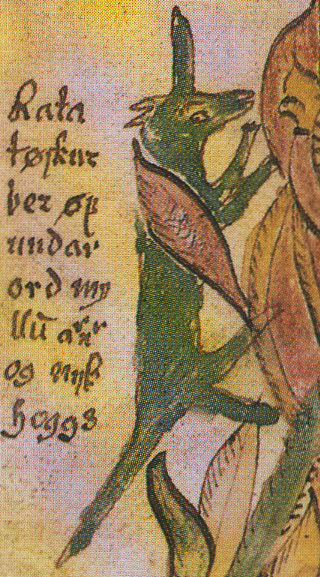 |
| Ratatoskr in a 17th century Icelandic manuscript. |
Type: nature spirit
Origin: Norse mythology
Description: Ratatoskr is... a squirrel. *grins* He climbs up and down Yggdrasil, the world tree, to take messages between the unnamed eagle at the top and the wyrm Níðhöggr who lives under one of the tree roots at the bottom. According to the 16th chapter of Prose Edda's Gylfaginning, Ratatoskr "runs up and down the ash. He tells slanderous gossip, provoking the eagle and Níðhöggr." Some say the fact Ratatoskr is portrayed as a lowly squirrel is due to his behavior in stirring up trouble.
Interesting Facts: He can be found in both the Poetic Edda, which is a compilation of Old Norse poems and a very important source of information about Norse mythology, as well as Prose Edda, which was written by Snorri Sturluson in approximately 1220. The Prose Edda contains eddic and skaldic poetry poetry about Norse mythology. For such a small creature, there's a lot of different theories on both his name and purpose/role in Norse mythology.
Have you heard of Ratatoskr before? Any "R" creatures or beings you know of?
Thursday, April 19
Q is for Qilin
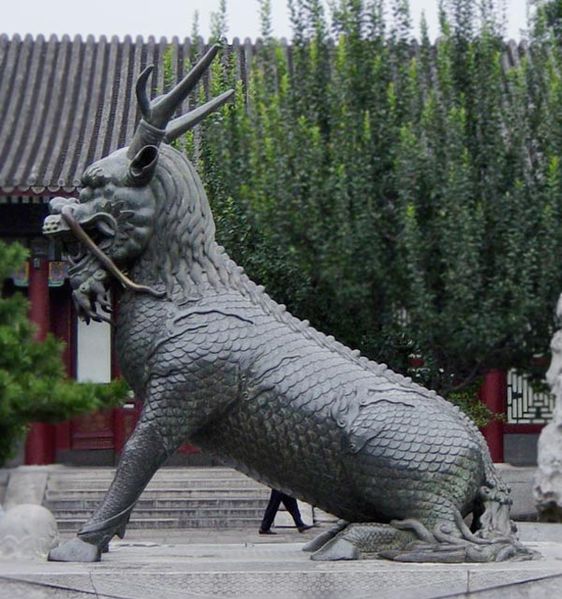 |
| A qilin of the Qing dynasty in Beijing's Summer Palace |
Type: Chinese chimera
Origin: Chinese mythology
Description: The Qilin is a hooved chimera sometimes portrayed as having parts of a fish, dragon, ox, lion and/or even a tiger. They are said to bring prosperity and only appear in land ruled by a peaceful or a wise man. For instance, the birth of Confucius was foretold by arrival of a Qilin.
The Qilin's origins are tied to Chinese exploration of Africa around the 5th century. The Zheng He's exploration of the areas around modern Somalia were successful, and they obtained some giraffes and other animals which they brought back to China. The word Geri, which in Somalia means giraffe, is the base word for Qilin. The slender high figure of the Qilin gave it special properties, such as walking on water and walking in grass without damaging the blades of the grass. The Qilin love the righteous and should anyone evil try to attack them while a Qilin is close by, the Qilin would attack the wicked by shooting flames from its mouth or using other powers.
Interesting Facts: The Chinese have the Qilin as their third most powerful creature after the dragon and the phoenix. This was not always been the case. Before the Qin-dynasty, the Qilin was ranked the highest. In Japan, the Kirin is the same as the Chinese Qilin. The Japanese still honor pre-Qin dynasty mythology and have the Kirin as the top creature in their culture.
What Q creatures or beings do you know of?
Wednesday, April 18
P is for Pixie
 |
| Illustration from Among Pixies and Trolls, a children's anthology |
Type: fairy or sprite-like being
Origin: Cornish folklore
Description: Pixies are very small beings that live mostly in the high moorland areas near Devon and Cornwall. They're also associated with exploring ocean caves. Usually, they are naked or scantly clothed and possess pointed ears and a pointed hat. Some say that pixies have wings, and others say they are without wings. One thing they especially enjoy is riding horses. While doing so, they make ringlets in the manes of the horses they ride. As for their demeanor, sometimes they kidnap children or mislead travelers (the cure for being pixie-led is to turn your coat inside out), but they not thought to be malevolent. They've been said to be help out widows and those in need at times.
Interesting Facts: Pixies lore predates Christianity in Britain, and the people in Cornwall and Devon took them quite seriously. To this day, there is a Pixie Day from an old tradition re-enacted annually on the Saturday in June nearest Mid-Summer's Day in Ottery St. Mary, England.
Have you heard of Pixies? Any other "P" beings or creatures you know of?
Tuesday, April 17
O is for Otso/Orpheus
Hey everyone! A couple bits of news first. Don't forget that I have the Hunky Hero giveaway going on. Also, Captive Moonlight is now on sale at All Romance eBooks (and at a discounted price!).
Anyways, today I'm doing a Finnish mythology being, but I have a tribute to an extra one based in Greek/Roman mythology that I couldn't let slip by.
Name: Otso (also known as Ohto, Kontio, metsän kuningas (the king of the forest), and mesikämmen (honeypaws) my favorite, lol)
Type: bear/nature spirit
Origin: Finnish mythology
Description: The Otso is basically a bear spirit. He's typically called friend, brother, uncle, or forest cousin (read below on its name). In some of the traditions, bears were thought to be relatives who had ran away from the community and were transformed by the forest's power.
Interesting Facts: Despite the long list of terms for it, this spirit wasn't properly named since the Finns did everything they could to avoid directly referring to it due to it being that sacred to them. They even have a ritual called Peijainen for if a bear was killed. There would be mourners and wailers for it. The bear's skull, which is where the bear's spirit resided, would be placed in a sacred clearing and taken care of and given gifts.
Now to the extra credit: Orpheus. He was a legendary musician, poet, and prophet in Greek mythology. His ability to play music and sing was seen as almost divine, and it charmed or entranced. His music even overrode that of the Sirens who were known for their bewitching voices.
There's some controversy over whether he was a coward or not (ahem, because he had caused the gods to allow him to go to the Underworld to try to bring Eurydice, his wife who died by snake bite after being chased by a satyr, back instead of... dying so he could be in Hades with her *rolls eyes*). They think he wasn't truly in love with her for that, and therefore that the gods had punished him and only gave him an apparition of his wife in the Underworld.
Regardless of all that, I enjoy picturing Orpheus as this guy someone caring and... err... attractive. ;-) Maybe it's the romantic in me. Here's Eurydice by Sleepthief. I've listened to this song so many times, and it's absolutely beautiful and romantic, even if it's also sad.
Tell me what you think! Also, can you name any other O beings or creatures?
Anyways, today I'm doing a Finnish mythology being, but I have a tribute to an extra one based in Greek/Roman mythology that I couldn't let slip by.
Name: Otso (also known as Ohto, Kontio, metsän kuningas (the king of the forest), and mesikämmen (honeypaws) my favorite, lol)
Type: bear/nature spirit
Origin: Finnish mythology
Description: The Otso is basically a bear spirit. He's typically called friend, brother, uncle, or forest cousin (read below on its name). In some of the traditions, bears were thought to be relatives who had ran away from the community and were transformed by the forest's power.
Interesting Facts: Despite the long list of terms for it, this spirit wasn't properly named since the Finns did everything they could to avoid directly referring to it due to it being that sacred to them. They even have a ritual called Peijainen for if a bear was killed. There would be mourners and wailers for it. The bear's skull, which is where the bear's spirit resided, would be placed in a sacred clearing and taken care of and given gifts.
Now to the extra credit: Orpheus. He was a legendary musician, poet, and prophet in Greek mythology. His ability to play music and sing was seen as almost divine, and it charmed or entranced. His music even overrode that of the Sirens who were known for their bewitching voices.
There's some controversy over whether he was a coward or not (ahem, because he had caused the gods to allow him to go to the Underworld to try to bring Eurydice, his wife who died by snake bite after being chased by a satyr, back instead of... dying so he could be in Hades with her *rolls eyes*). They think he wasn't truly in love with her for that, and therefore that the gods had punished him and only gave him an apparition of his wife in the Underworld.
Regardless of all that, I enjoy picturing Orpheus as this guy someone caring and... err... attractive. ;-) Maybe it's the romantic in me. Here's Eurydice by Sleepthief. I've listened to this song so many times, and it's absolutely beautiful and romantic, even if it's also sad.
Tell me what you think! Also, can you name any other O beings or creatures?
Monday, April 16
N is for Nereid
Here is today's A to Z Challenge post. It's is a quickie since I'm also doing the Hunky Hero BlogHop today.
Name: Nereid
Type: sea nymph
Origin: Greek mythology
Description: The Nereids are the fifty daughters of Nereus and Doris and sisters to Nerites. They are sea nymphs and often accompany Poseidon. Their demeanor is friendly, and they help sailors who are fighting dangerous storms. They live in and are associated with the Aegean Sea.
Interesting Facts: One of the moons of Neptune is named Nereid after them since they were attendants of Neptune (Poseidon in Greek mythology). Notable Nereids are Thetis, the mother of Achilles, and Amphitrite, wife of Poseidon.
Have you heard of the Nereids? Are there any N beings or creatures you know of?
Name: Nereid
Type: sea nymph
Origin: Greek mythology
Description: The Nereids are the fifty daughters of Nereus and Doris and sisters to Nerites. They are sea nymphs and often accompany Poseidon. Their demeanor is friendly, and they help sailors who are fighting dangerous storms. They live in and are associated with the Aegean Sea.
Interesting Facts: One of the moons of Neptune is named Nereid after them since they were attendants of Neptune (Poseidon in Greek mythology). Notable Nereids are Thetis, the mother of Achilles, and Amphitrite, wife of Poseidon.
Have you heard of the Nereids? Are there any N beings or creatures you know of?
Saturday, April 14
M is for Minotaur
Name: Minotaurs, which means the "Bull of Minos."
Origin: Greek Mythology
Type: Human Hybrid
Description: A little bit about the Minotaur. He has the head of a bull and the body of a man. His parents are the Cretan Bull and Pasiphaë. Pasiphaë was married to King Minos of Crete, but after King Minos had prayed to Poseidon and received support from him, he was supposed to kill the Cretan Bull. He thought it was so beautiful that he couldn't, so he sacrificed one of his own bulls.
For his punishment, Pasiphaë fell in love with the Cretan Bull and had the architect Daedalus build a hollow wooden cow so she could mate with the bull. Minotaur was nursed by his mother until he became fierce and began devouring men. He lives at the center of the Cretan Labyrinth, which was constructed by Daedalus and his son by command of King Minos of Crete.
Interesting Facts: One of the future Athenian king Theseus's acts which helped him to secure his throne was to slay the Minotaur. Also, since some sources don't specify which end is part bull and which is part human, sometimes the Minotaur has a bull's lower half and a human torso.
Have you heard of the Minotaur before?
Origin: Greek Mythology
Type: Human Hybrid
Description: A little bit about the Minotaur. He has the head of a bull and the body of a man. His parents are the Cretan Bull and Pasiphaë. Pasiphaë was married to King Minos of Crete, but after King Minos had prayed to Poseidon and received support from him, he was supposed to kill the Cretan Bull. He thought it was so beautiful that he couldn't, so he sacrificed one of his own bulls.
For his punishment, Pasiphaë fell in love with the Cretan Bull and had the architect Daedalus build a hollow wooden cow so she could mate with the bull. Minotaur was nursed by his mother until he became fierce and began devouring men. He lives at the center of the Cretan Labyrinth, which was constructed by Daedalus and his son by command of King Minos of Crete.
Interesting Facts: One of the future Athenian king Theseus's acts which helped him to secure his throne was to slay the Minotaur. Also, since some sources don't specify which end is part bull and which is part human, sometimes the Minotaur has a bull's lower half and a human torso.
Have you heard of the Minotaur before?
Thursday, April 12
K is for Kalma
Today, you guys get a two for one. We're dealing with both the goddess and spirits of the recently passed. :-) We also have a special Interesting Facts from my husband. Enjoy!
Name: Kalma (means "The Stench of Corpses")
Type: Finnish goddess of death and decay
Origin: Finnish mythology
Description: As noted in the meaning of her name, she smells of death and decay. She lives in the Finnish Underworld called Tuonela. Surma, a beast often described as a large dog with a snake's tail, accompanies her and guards the gates of Tuonela. He makes sure the dead stay in and the living stays out.
Interesting Facts (brought to you by my Finnish husband): In Finnish culture, the dead and recently passed have always held respect of those who were left behind afterwards. The old sayings of not to speak ill of the dead is directly related to the kalmas.
Kalmas, the spirits of the recently passed, typically lived in the world as passing spirits until they entered the afterlife (Tuonela) or were forced to vacate the area they were possessing. Sometimes the mortal bounds held the spirits in the physical world so strong that the Death was not able to relieve them.
Should the body not be completely decomposed, the spirit could re-inhabit the body with a mere effort, vitalizing it enough to walk around the living and typically to seek resolution or revenge
The early Christianity that came to Finland gave Kalmas another feature. It was said that some spirits were so religious and so tied to their home church that every Christmas eve the dead, the Kalmas and ghosts rose up from their resting places to worship on Christmas eve's night. Along with a priest kalma.
Should one stay long near the dying and the deceased, they could contact the spiritual essence of the dead to themselves, and thus pass disease or death among the living without knowing it. One had to perform a set of rites of passage to prevent any dead spirits from passing with them as they were dealing with the dead and the diseased to prevent this. Tietäjäs (the shamans of the Finns) could typically see the dead and to command them, requesting the Kalma to hold her people (the kalmas) from taking the diseased from their homes into an early grave.
The Finnish necromancy was not wide-spread, but the dead and the Kalma was worshipped, and the dead were sometimes used as messengers, as mentors and even allies toward a specific goal. One had to pay respects to the dead, and pay them typically with blood of an animal, or by jewelry or gold to prevent them from attacking those who had requested their aid.
Name: Kalma (means "The Stench of Corpses")
Type: Finnish goddess of death and decay
Origin: Finnish mythology
Description: As noted in the meaning of her name, she smells of death and decay. She lives in the Finnish Underworld called Tuonela. Surma, a beast often described as a large dog with a snake's tail, accompanies her and guards the gates of Tuonela. He makes sure the dead stay in and the living stays out.
Interesting Facts (brought to you by my Finnish husband): In Finnish culture, the dead and recently passed have always held respect of those who were left behind afterwards. The old sayings of not to speak ill of the dead is directly related to the kalmas.
Kalmas, the spirits of the recently passed, typically lived in the world as passing spirits until they entered the afterlife (Tuonela) or were forced to vacate the area they were possessing. Sometimes the mortal bounds held the spirits in the physical world so strong that the Death was not able to relieve them.
Should the body not be completely decomposed, the spirit could re-inhabit the body with a mere effort, vitalizing it enough to walk around the living and typically to seek resolution or revenge
The early Christianity that came to Finland gave Kalmas another feature. It was said that some spirits were so religious and so tied to their home church that every Christmas eve the dead, the Kalmas and ghosts rose up from their resting places to worship on Christmas eve's night. Along with a priest kalma.
Should one stay long near the dying and the deceased, they could contact the spiritual essence of the dead to themselves, and thus pass disease or death among the living without knowing it. One had to perform a set of rites of passage to prevent any dead spirits from passing with them as they were dealing with the dead and the diseased to prevent this. Tietäjäs (the shamans of the Finns) could typically see the dead and to command them, requesting the Kalma to hold her people (the kalmas) from taking the diseased from their homes into an early grave.
The Finnish necromancy was not wide-spread, but the dead and the Kalma was worshipped, and the dead were sometimes used as messengers, as mentors and even allies toward a specific goal. One had to pay respects to the dead, and pay them typically with blood of an animal, or by jewelry or gold to prevent them from attacking those who had requested their aid.
Wednesday, April 11
J is for Jörmungandr
 |
| "Thor in Hymir's boat battling the Midgard Serpent" (1788) by Henry Fuseli |
Type: Legendary serpent, son of Loki
Origin Norse mythology
Description: Jörmungandr was one of three children of Loki and Angrboða. In the Prose Edda, an Icelandic collection which includes tales from Norse mythology, Odin "tossed Jörmungandr into the great ocean that encircles Midgard. The serpent grew so large that he was able to surround the earth and grasp his own tail. As a result, he received the name of the Midgard Serpent or World Serpent. When he lets go, the world will end."
Interesting Facts: Thor is the Jörmungandr's arch-enemy. They are mentioned in three myths together. Loki and Angrboða's other two children are Fenrir and Hel.
Have you heard of the Jörmungandr before?
Tuesday, April 10
I is for Imp
Welcome back for today's creature, sponsored by the letter... I.
First though, I have some newsy bits to share. Jungle Fire is now available at Amazon.com. Hop on over there and take a look (after today's post, of course. ;-))
Name: Imp
Type: lesser demons
Origin: Germanic mythology
Description: Small, unattractive boarding on ugly creatures. Imps, while usually associated with black arts, are not always evil, but merely mischievous and pranksters, as they do not strive to harm their victims. They usually act very wild and uncontrollable. Most often, they're viewed as immortals. Typically, they are familiars who serve witches or warlocks as informants.
Sometimes imps seek friendship with humans since they're often portrayed as lonely. Usually their pranks drove away the people or when they found a friend, they were described as impish for their love of practical jokes.
Interesting Facts: Some Germanic tales consider imps to be more closely tied to fairies due to the fact that they're more playful and show a variety of interests, unlike their more infernal cousins.
They're very commonly used in computer games/video games due to the fact that they are known as servants to magical beings. Examples are World of Warcraft, The Legend of Zelda, and Dante's Inferno.
Click here for more information and pictures of them.
Have you heard of imps before?
First though, I have some newsy bits to share. Jungle Fire is now available at Amazon.com. Hop on over there and take a look (after today's post, of course. ;-))
Type: lesser demons
Origin: Germanic mythology
Description: Small, unattractive boarding on ugly creatures. Imps, while usually associated with black arts, are not always evil, but merely mischievous and pranksters, as they do not strive to harm their victims. They usually act very wild and uncontrollable. Most often, they're viewed as immortals. Typically, they are familiars who serve witches or warlocks as informants.
Sometimes imps seek friendship with humans since they're often portrayed as lonely. Usually their pranks drove away the people or when they found a friend, they were described as impish for their love of practical jokes.
Interesting Facts: Some Germanic tales consider imps to be more closely tied to fairies due to the fact that they're more playful and show a variety of interests, unlike their more infernal cousins.
They're very commonly used in computer games/video games due to the fact that they are known as servants to magical beings. Examples are World of Warcraft, The Legend of Zelda, and Dante's Inferno.
Click here for more information and pictures of them.
Have you heard of imps before?
Monday, April 9
H is for Hiisi
I hope everyone had a Happy Easter! Today's trip takes us back to Finland we go for the letter H.
Name: Hiisi (originally meant "holy place" or "sacred grove")
Type: Goblin-like guardian spirit
Origin: Finnish mythology
Description: As seen by it's original name meaning, hiisi was originally seen as the awesomeness of nature. After Christian influence, they were seen as mean or at least horrifying evil spirits of small stature. They live near "salient promontories, ominous crevasses, large boulders, potholes, woods, hills, and other awesome geographical features or rough terrain." Hiisis (Finnish plural is hiidet) travel noisily, and if people don't get out of their way, they attack. Also, if a person left their door open, hiisis would go inside and steal something of his or her possessions.
In Finland's national epic, The Kalevala, Hiisi was one of the twelve sons of Kaleva. He is in Poems 13-14, when Lemminkäinen is after his elk.
Interesting Facts: They were originally thought to be tall like giants, so their diminished size is kind of interesting. In Finnish, a giant's kettle is hiidenkimu, which means hiisi's churn. Also, in J.R.R. Tolkien's books, hiisi is used for the word goblin whereas orc is örkki.
An old folk saying is that one must put (and keep) their knives (puukkos) in their sheaths when entering someone's home. Otherwise a spirit of hiisi would enter the home in the empty sheath and create chaos.
Have you heard of hiisis before?
Name: Hiisi (originally meant "holy place" or "sacred grove")
Type: Goblin-like guardian spirit
Origin: Finnish mythology
Description: As seen by it's original name meaning, hiisi was originally seen as the awesomeness of nature. After Christian influence, they were seen as mean or at least horrifying evil spirits of small stature. They live near "salient promontories, ominous crevasses, large boulders, potholes, woods, hills, and other awesome geographical features or rough terrain." Hiisis (Finnish plural is hiidet) travel noisily, and if people don't get out of their way, they attack. Also, if a person left their door open, hiisis would go inside and steal something of his or her possessions.
In Finland's national epic, The Kalevala, Hiisi was one of the twelve sons of Kaleva. He is in Poems 13-14, when Lemminkäinen is after his elk.
Interesting Facts: They were originally thought to be tall like giants, so their diminished size is kind of interesting. In Finnish, a giant's kettle is hiidenkimu, which means hiisi's churn. Also, in J.R.R. Tolkien's books, hiisi is used for the word goblin whereas orc is örkki.
An old folk saying is that one must put (and keep) their knives (puukkos) in their sheaths when entering someone's home. Otherwise a spirit of hiisi would enter the home in the empty sheath and create chaos.
Have you heard of hiisis before?
Saturday, April 7
G is for Green Man
Today's trip spans the world as this being brought to you by the letter G is found in many cultures.
Name: Green Man (this term originates from 1939 in The Folklore Journal)
Type: Nature Spirit and/or vegetative deity
Origin: True origin unknown. There's a multitude of variations from different ancient cultures.
Description: The Green Man is a very old primal nature spirit that is closely tied to the cycle of life and nature. It's commonly seen as rebirth or renaissance and is viewed a part of the seasonal growth during Spring. He's typically seen as an older man wearing green, even though he can take on a multitude of forms. Most view him as a type of woodland spirit. He has been considered similar to Odin, the Holly King, and Jack in the Green.
He's found carved in wood or stone in churches all over. He's appears most commonly in three forms.
Interesting Facts: The Green Man can be found in one form or another around the world. The Green Knight is Sir Gawain and the Green Knight is viewed as similar to the Green Man as well as Robin Hood, due to the close ties with woodlands and green clothing/armor. The Green Man can also be viewed as a great living tree, similar to Tolkien's walking, self-aware trees. Also, in some of his variations, he is depicted in roles similar to Odin and Osiris.
On a side note, he seems awfully similar to the Jolly Green Giant, huh? Ho, ho, ho... *grin*
Source: Wikipedia.
Type: Nature Spirit and/or vegetative deity
Origin: True origin unknown. There's a multitude of variations from different ancient cultures.
Description: The Green Man is a very old primal nature spirit that is closely tied to the cycle of life and nature. It's commonly seen as rebirth or renaissance and is viewed a part of the seasonal growth during Spring. He's typically seen as an older man wearing green, even though he can take on a multitude of forms. Most view him as a type of woodland spirit. He has been considered similar to Odin, the Holly King, and Jack in the Green.
He's found carved in wood or stone in churches all over. He's appears most commonly in three forms.
- Foliate Head - covered in green leaves
- Disgorging Head - spews leaves and vines from mouth
- Bloodsucker Head - sprouts leaves and vines from mouth and other orifices (No clue why it's called that. *grin*)
Interesting Facts: The Green Man can be found in one form or another around the world. The Green Knight is Sir Gawain and the Green Knight is viewed as similar to the Green Man as well as Robin Hood, due to the close ties with woodlands and green clothing/armor. The Green Man can also be viewed as a great living tree, similar to Tolkien's walking, self-aware trees. Also, in some of his variations, he is depicted in roles similar to Odin and Osiris.
On a side note, he seems awfully similar to the Jolly Green Giant, huh? Ho, ho, ho... *grin*
Source: Wikipedia.
Friday, April 6
F is for Fear dearg
Today's journey takes us to Ireland to search out a creature that starts with the letter F.
Name: Fear dearg, also known as far darrig (means "Red Man")
Type: Solitary fairy (a classification of fairies who live alone and tend to be malicious and wicked)
Origin: Irish mythology
Description: The fear dearg lives up to its name in that he wears a red cap and coat. The Fairy and Folk Tales of Irish Peasantry book points out that they tend to be "most sluttish, slouching, jeering, mischievous phantoms." And it goes on to say that the fear dearg "busies himself with practical joking, especially with gruesome joking."
Interesting Fact: This fairy is used in Laurell K. Hamilton's Merry Gentry series in Divine Misdemeanors as well as in the Callahan's Crosstime Saloon book series's "The Callahan Touch" which has a character who is a mix of fear dearg and pooka.
Have you heard of the fear dearg/far darrig before? If so where?
Name: Fear dearg, also known as far darrig (means "Red Man")
Type: Solitary fairy (a classification of fairies who live alone and tend to be malicious and wicked)
Origin: Irish mythology
Description: The fear dearg lives up to its name in that he wears a red cap and coat. The Fairy and Folk Tales of Irish Peasantry book points out that they tend to be "most sluttish, slouching, jeering, mischievous phantoms." And it goes on to say that the fear dearg "busies himself with practical joking, especially with gruesome joking."
Interesting Fact: This fairy is used in Laurell K. Hamilton's Merry Gentry series in Divine Misdemeanors as well as in the Callahan's Crosstime Saloon book series's "The Callahan Touch" which has a character who is a mix of fear dearg and pooka.
Have you heard of the fear dearg/far darrig before? If so where?
Subscribe to:
Posts (Atom)


