Showing posts with label folklore. Show all posts

Tuesday, April 10

I is for Imp

Welcome back for today's creature, sponsored by the letter... I.

First though, I have some newsy bits to share. Jungle Fire is now available at Amazon.com. Hop on over there and take a look (after today's post, of course. ;-))

Name: Imp

Type: lesser demons

Origin: Germanic mythology

Description: Small, unattractive boarding on ugly creatures. Imps, while usually associated with black arts, are not always evil, but merely mischievous and pranksters, as they do not strive to harm their victims. They usually act very wild and uncontrollable. Most often, they're viewed as immortals. Typically, they are familiars who serve witches or warlocks as informants.

Sometimes imps seek friendship with humans since they're often portrayed as lonely. Usually their pranks drove away the people or when they found a friend, they were described as impish for their love of practical jokes.

Interesting Facts: Some Germanic tales consider imps to be more closely tied to fairies due to the fact that they're more playful and show a variety of interests, unlike their more infernal cousins.

They're very commonly used in computer games/video games due to the fact that they are known as servants to magical beings. Examples are World of Warcraft, The Legend of Zelda, and Dante's Inferno.

Click here for more information and pictures of them.

Have you heard of imps before?

Monday, April 9

H is for Hiisi

I hope everyone had a Happy Easter! Today's trip takes us back to Finland we go for the letter H.

Name: Hiisi (originally meant "holy place" or "sacred grove")

Type: Goblin-like guardian spirit

Origin: Finnish mythology

Description: As seen by it's original name meaning, hiisi was originally seen as the awesomeness of nature. After Christian influence, they were seen as mean or at least horrifying evil spirits of small stature. They live near "salient promontories, ominous crevasses, large boulders, potholes, woods, hills, and other awesome geographical features or rough terrain." Hiisis (Finnish plural is hiidet) travel noisily, and if people don't get out of their way, they attack. Also, if a person left their door open, hiisis would go inside and steal something of his or her possessions.

In Finland's national epic, The Kalevala, Hiisi was one of the twelve sons of Kaleva. He is in Poems 13-14, when Lemminkäinen is after his elk.

Interesting Facts:  They were originally thought to be tall like giants, so their diminished size is kind of interesting. In Finnish, a giant's kettle is hiidenkimu, which means hiisi's churn. Also, in J.R.R. Tolkien's books, hiisi is used for the word goblin whereas orc is örkki.

An old folk saying is that one must put (and keep) their knives (puukkos) in their sheaths when entering someone's home. Otherwise a spirit of hiisi would enter the home in the empty sheath and create chaos.

Have you heard of hiisis before?

Saturday, April 7

G is for Green Man

Today's trip spans the world as this being brought to you by the letter G is found in many cultures.

Name: Green Man (this term originates from 1939 in The Folklore Journal)

Type: Nature Spirit and/or vegetative deity

Origin: True origin unknown. There's a multitude of variations from different ancient cultures.

Description: The Green Man is a very old primal nature spirit that is closely tied to the cycle of life and nature. It's commonly seen as rebirth or renaissance and is viewed a part of the seasonal growth during Spring. He's typically seen as an older man wearing green, even though he can take on a multitude of forms. Most view him as a type of woodland spirit. He has been considered similar to Odin, the Holly King, and Jack in the Green.

He's found carved in wood or stone in churches all over. He's appears most commonly in three forms.

  • Foliate Head - covered in green leaves
  • Disgorging Head - spews leaves and vines from mouth
  • Bloodsucker Head - sprouts leaves and vines from mouth and other orifices (No clue why it's called that. *grin*)

Interesting Facts: The Green Man can be found in one form or another around the world. The Green Knight is Sir Gawain and the Green Knight is viewed as similar to the Green Man as well as Robin Hood, due to the close ties with woodlands and green clothing/armor. The Green Man can also be viewed as a great living tree, similar to Tolkien's walking, self-aware trees. Also, in some of his variations, he is depicted in roles similar to Odin and Osiris.

On a side note, he seems awfully similar to the Jolly Green Giant, huh? Ho, ho, ho... *grin*

Source: Wikipedia.

Tuesday, April 3

C is for Chupacabras

Welcome back for today's letter... C! Today, we're traveling to North and Central America for this creature.

Name: Chupacabras (means "goat sucker") Chupacabra is also used, but it is a regularized form of the original word.

Type: Bloodsucking creature

Origin: Puerto Rican and Latin American folklore

Description: The chupacabras is most commonly described as a reptile-like creature with scaly skin and sharp spines running along its back. It supposedly hops like a kangaroo and has sharp fangs, a forked tongue, and stands about 3-4 feet tall. It's also described as smelling like sulfur. A less common description of the chupacabras is a hairless wild dog with a pronounced spine, fangs, and claws. It is supposed to look like a dog-reptile hybrid.

When it bites it drains out the victim's blood (like a vampire) and even their organs sometimes. The bite mark is said to be either three holes in the shape of an upside-down triangle, two holes, or one, which isn't a very definite answer. *grin*

Interesting Facts: Chupacabras received its name from the fact that it has a habit of attacking livestock, and particularly goats. It was first reportedly spotted in 1995 in Puerto Rico. Biologists and others who have researched it conclude that the chupacabras are merely coyotes, or dogs, with mange, which explains the less common description of the vampire-like beast. It's been featured in many books, video games, TV shows, and movies.

Have you heard of the Chupacabras before? If so, where did you learn about it?

Monday, March 5

Transylvania - Score a Kindle and Gift Card

Today we're going Transylvania-themed in celebration of the huge event Barbara Vey is having today on her blog! I helped donate a Kindle and an Amazon Gift Certificate with seven other authors. For the chance to win the KINDLE and $50 Gift Certificate to Amazon, visit Barbara Vey's blog at http://BeyondHerBook.com for more information!

*  *  *

Since Barbara's theme is Transylvania, I decided to share some Romanian folklore today.

A Zmeu is of Romanian folklore and mythology. It's basically a slavic dragon with anthropomorphic features, namely its humanoid legs, arms, and ability to use and make possession such as weapons. His magical powers include the ability to shapeshift, fly, and spit fire. He has supernatural strength.

In Romanian mythology, the zmeu is seen as the embodiment of selfishness and greed. He typically steals something that's very important, and Făt-Frumos, the Romanian version of "Prince Charming," has to gain it back through his selfless bravery. Even though the zmeu has amazing abilities, it's no match for Făt-Frumos.

In Moldavia, a zmeu is sometimes pictured as a vampire-like creature that takes the shape of a flame then goes in the room of a young girl or widow. Once inside, he becomes a man and seduces her.

Interesting Tidbits:
  • The name zmeu most likely comes from the Slavic word Zmey, which is a Slavic dragon with three heads. The plural form is zmei, and the feminine forms are zmeoaică and (fem. plural) zmeoaice.
  • Some English translations refer to a zmeu as a variation of an ogre or giant from western European mythologies. Like ogres, a zmeu kidnaps a maiden to be his wife in his otherworldly realm.
  • The word zmeu also refers to the kites that children fly. It's also the word for dragon in German, Russian, Norwegian, Swedish and Scottish English.

Wednesday, May 4

Into the Paranormal: Bigfoot

So, we talked about the Yeti not long ago. Today we'll be discussing his North American counterpart today, the Bigfoot. Typically described as being very tall (between seven and ten feet), having a powerful build, bipedal, and covered in dark red fur, he also has big feet. Surprising, right? According to wikipedia.org, "the enormous footprints for which it is named have been as large as 24 inches (60 cm) long and 8 inches (20 cm) wide."

He's mainly spotted in the Pacific Northwest, but there have been supposed sightings across the country. Even as far away as Texas and Florida. He resides in forests.

Members of the Lummi tribe told about experiences with "Ts'emekwes," their version of Bigfoot. Another version is the stiyaha, which were nocturnal creatures that children were warned to not speak its name for fear of the monsters coming to drag someone away to kill them. And even another version from Native Americans residing in Spokane, Washington is that the creatures lived on the peaks of mountains and stole salmon from the fishing nets.

Interesting Tidbits:
  • He's also known as Sasquatch, which is derived from "Sésquac" meaning "wild man" in a Salishan (Native American) language from the Pacific Northwest. 
  • Some believe that a story in Theodore Roosevelt's 1892 book The Wilderness Hunter that tells of an event between a couple of hunters and a pissed-off bear could actually be historical evidence of Bigfoot's existence.
  • Most believe that Bigfoot encounters are either misidentification of mangy bears or hoaxes. Some think that the Bigfoot could be an extinct Gigantopithecus (giant ape) or an extinct hominidae (also an ape). Still Bigfoot believers are positive that he's out there.
What do you think? Is Bigfoot real? Give me your thoughts on the subject. Have you seen a movie or read a book with him in it?

Saturday, April 30

Z is for Zmeu

Woohoo! So, we've made it to the end of the A to Z Challenge. Who else is really excited about that? First of all, I'd like to say Thank You to everyone who has stopped by, commented, and followed my blog. You guys and gals have blown my mind! It's been a phenomenal month getting to meet everyone.

And now onto today's topic. A Zmeu is of Romanian folklore and mythology. It's basically a slavic dragon with anthropomorphic features, namely its humanoid legs, arms, and ability to use and make possession such as weapons. His magical powers include the ability to shapeshift, fly, and spit fire. He has supernatural strength.

In Romanian mythology, the zmeu is seen as the embodiment of selfishness and greed. He typically steals something that's very important, and Făt-Frumos, the Romanian version of "Prince Charming," has to gain it back through his selfless bravery. Even though the zmeu has amazing abilities, it's no match for Făt-Frumos.

In Moldavia, a zmeu is sometimes pictured as a vampire-like creature that takes the shape of a flame then goes in the room of a young girl or widow. Once inside, he becomes a man and seduces her.

Interesting Tidbits:
  • The name zmeu most likely comes from the Slavic word Zmey, which is a Slavic dragon with three heads. The plural form is zmei, and the feminine forms are zmeoaică and (fem. plural) zmeoaice.
  • Some English translations refer to a zmeu as a variation of an ogre or giant from western European mythologies. Like ogres, a zmeu kidnaps a maiden to be his wife in his otherworldly realm.
  • The word zmeu also refers to the kites that children fly. It's also the word for dragon in German, Russian, Norwegian, Swedish and Scottish English.
Have you heard of the Zmeu before? What do you think of them? Have you enjoyed the A to Z Challenge this month?

Friday, April 29

Y is for Yeti

The Yeti, also known as the Abominable snowman, is an ape-like creature that prefers the frozen mountain ranges of Himalaya, Nepal, India and Tibet. Meh-Teh is the common term it's known as in the region.

While similar to Bigfoot, the Yeti's North American counterpart, the Yeti differs in both preferred terrain, temperature and general surroundings. Men have hunted the Bigfoot with fervor, but the Himalayan mountains give plenty of cover and peace to the Yeti, as well as act as a natural deterrent to eager hunters.

The few eyewitness reports available say that the Yeti is a large creature that walks on two legs. It has a massive frame and ape-like features. The size of markings found in the snow suggest a creature, or creatures, able to walk great distances and reach to heights that normal humans, and sometimes even Sherpas, would have difficulty reaching.

Interesting Tidbit:
  • In 1960, Sir Edmund Hillary, a New Zealand mountaineer, went in search of physical evidence of the Yeti existence. After sending a Yeti scalp from the Khumjung monastery to the West to be tested, the results showed it was probably the scalp from a Himalayan antelope. Anthropologist Myra Shackley didn't agreed saying that the "hairs from the scalp look distinctly monkey-like and that it contains parasitic mites of a species different from that recovered from the serow." (The Himalyan antelope is a serow.)
  • Walt Disney World's roller coaster Expedition Everest contains a 25-foot-tall audio-animatronic Yeti during the ride.
  • For a list of movies, songs, and other popular culture items that feature the Yeti: click here.
Have you heard of the Yeti before? Seen references to it in pop culture? Let me know!

Wednesday, April 13

K is for Kraken

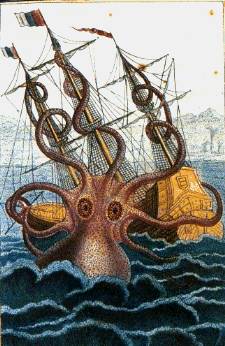
The sea with its vast size has always created stories and lore of its own, ranging from whirlpools the size of small islands to magical creatures and even stories about the ends of the earth. However, few things strike seafarers with as much fear as the Kraken.

It is a massive squid capable of sinking warships and dragging them to the bottom of the sea, meanwhile creating a whirlpool that sucks down other nearby ships for miles around.

Kraken is viewed as an intelligent force of nature and the embodiment of the raging sea. It is one of the oldest and most often referred sea monsters throughout history. Its origins are tied to the Norway and Iceland, but similar stories of Kraken exists throughout seafaring cultures.

Sure, Kraken sounds like it could merely be a legend of old, but not so, there have been multiple sightings of giant squid across the globe, particularly throughout northern hemisphere and trade routes once used by Vikings. An even larger subspecies of squid, the colossal squid, has been found in the wild and reaches 33ft and possibly longer.

These recent findings suggest that there is something more to this mythological creature than meets the eye, or tentacle. Harr... harr... *grins*

Interesting Tidbits:

  • It has been the inspiration for a variety of books and movies. Here's a link to some of those. 
  • It is usually described as being the size of a floating island and has a flotilla of smaller fish accompanying it, which makes it attractive to fishermen despite the danger. A common saying when one has great catches is, "You must have fished on Kraken."
  • Seaworld Orlando has a roller coaster ride called Kraken. Although, their version is of a huge "dragon eel." Regardless, it's very fun!
So, how about you? Have you read a book, seen a movie, or been on a roller coaster ride based off the Kraken?

Monday, April 11

I is for Incubus

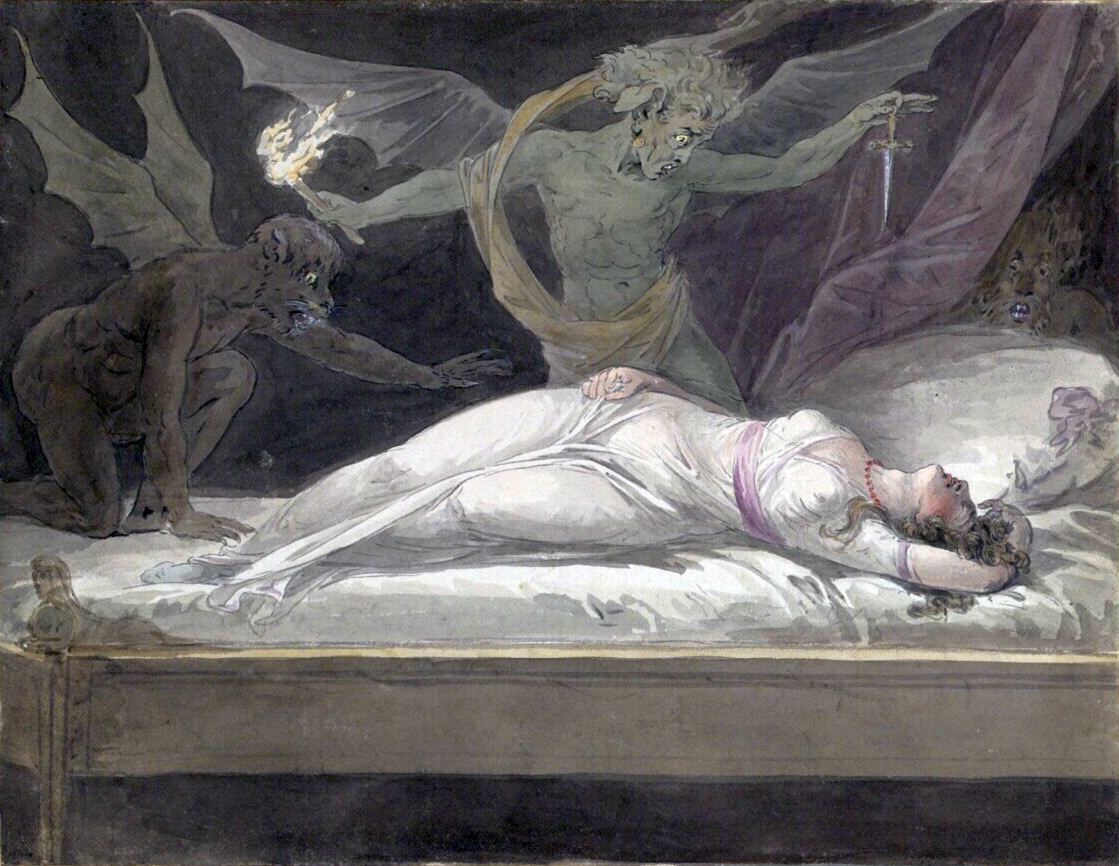
An Incubus is a male demon that comes upon a woman when they're asleep and has intercourse with them, usually with the purpose of trying to impregnate her with his child. According to religious beliefs, continued visits by an incubus lead to the deterioration of one's health and eventually death. It also corrupts both the moral and mental aspects of the female.

These nighttime visitors were the embodiments of sexual seduction during the medieval times. They were often used to explain pregnancies out of wedlock as well as rape inflicted on the sleeping woman by someone close to the victim. The latter used it as a way to escape punishment for their actions.

The most well-known offspring of an incubus and woman, known as a cambion, is Merlin the powerful wizard from Arthurian legend. Cambion typically grown up to be powerful magic users or evildoers.

Interesting Tidbits:
  • The word incubus comes from the Latin "incubus," which means "nightmare."
  • Some consider succubi and incubi to be a single demon capable of lying with both genders, while others declare that they are two separate entities.
  • The earliest mention of incubi and succubi are from 2400 BC in ancient Mesopotamian manuscript Sumerian King List. The hero Gilgamesh's father is a "Lilu," which shares the same attributes as an incubus in that they both seduce women while they sleep.
What are your thoughts on the Incubi (or Succubi)? Have you experienced any books, movies, or games with them in it?

Friday, April 8

G is for Gnome

Gnomes are a more recent addition to European folklore. The earliest mentions of them date to the 16th century. Male gnomes wear red pointy caps, have big beards, and usually have a tool belt, which relates to the fact that they're technologically inclined. Female gnomes tend to wear more muted colors, has her hair in braids, and begins to grow a light beard when she reaches 350 years of age. They are very small in size, usually ranging from 5 inches to 2 feet tall depending on the source. Both genders have a very long lifespan.

German Garden Gnome
Gnomes are considered more human than their more unluckier cousins and fierce rivals, goblins. Both are viewed as a type of a earth spirit, but gnomes are known as inventors and alchemists, while goblins use crude but effective tools. Gnomes also tend to be capable of earth-related magic.

There are several different types of gnomes. Woodland gnomes, Dune gnomes, House gnomes, Farm gnomes, Garden gnomes, and Siberian gnomes. Woodland and Dune gnomes avoid contact with humans. House and Farm are good-natured and more likely to interact with humans. Garden gnomes enjoy living in older gardens and telling depressing stories. The Siberian gnome is meaner and takes revenge for even the smallest of offenses.

Interesting Tidbits:
  • The origin of the word gnome comes from Latin word gēnomos, which means "earth-dweller." In the 16th Century, a Swiss alchemist named Paracelsus first wrote about gnomus omitting the "ē," which the OED noted was a blunder. The word as we know it today came about in the early 18th century, but it became popular in the 19th century due to their popularity in children's fairy tales.
  • In Scandinavian mythology, they're thought to have always existed but were mostly considered related to other beings, such as fairy or fey.
  • During the 20th century, due to the popularity of 19th century fairy tales, gnomes became synonymous with other domestic spirits, which protected the residence and did household chores, losing their distinctness of being tied to earthy, subterranean lives.
Here's a fun video from the video game Fable 3, which features a gnome hurling insults at the main character. It's pretty darn funny.


Who are your favorite Gnomes? What books, movies, or games have you enjoyed with them in it? Has anyone seen the newish movie Gnomeo and Juliet?

Wednesday, April 6

E is for Elf

Yes, it's true! Today's topic for the A to Z challenge isn't as obscure as the past two have been. Surprisingly, I racked my brain trying to think of a topic today before smacking myself upside the head. Scary really, since a life-sized Legolas shares my office with me.

Legolas from Lord of the Rings.
So, Elves are beings originally from Germanic mythology (basically Old Norse, Old English, and German). They're also featured in modern folklore (Scandinavian, German, English & Scottish, and don't forget Santa's helpers). In Norse mythology, they're divided between light elves (Ljósálfar) and dark elves (Dökkálfar). They have magical powers which they can use to help mankind or hurt it. Also, they're very connected with nature and tend to live in forests and away from people.

Appearance-wise, elves are famous for their pointed ears and delicate beauty. Light elves tend to look like my friend Legolas up there with light hair, pale skin, and blue eyes. Dark elves, on the other hand, have black hair, dark eyes, and black skin. In terms of behavior, while dark elves tend to stay away from people and can be slightly hostile, light elves are willing to talk to people provided you're able to meet one.

Having a dislike in iron (since it limits their powers), elves prefer the finer metals of silver or gold. Their normal working tools tend to be bronze. This is one of the reasons why elves utilize bows and arrows, as well as the obvious advantage of having their enemies at a distance.

Elves have become a staple to the fantasy genre both in literature and gaming, helped by the success of the hugely popular roleplaying game Dungeons and Dragons.

Interesting Tidbits:
  • Some variations of elves depict them as very small-statured. This was especially prominent in Victorian literature.
  • The way elves appear in the high fantasy genre and J.R.R. Tolkien's work (Lord of the Rings, etc.) comes from influence of 19th century Romanticism and its depiction of them being very beautiful beings.
  • Santa's helpers "Christmas elves" became popular in the 1870s.
It's your turn! Who are your favorite Elves? What books, movies, or games have you enjoyed with them in it?

Tuesday, April 5

D is for Dhampir

Dhampirs are from Balkan (gypsy) folklore. They are born of a vampire father and a human mother. Dhampirs are dual-natured sort of like the Centaurs yesterday. They're forced to walk between their undead side and their mortal side; although, they are more human than vampire. They possess vampiric powers without the weaknesses, but their physical and supernatural strength is less than that of a vampire due to being a half-breed. They tend to be unusually good at tracking and hunting vampires.

Additionally, vampires tend to target dhampirs since they're viewed as a serious threat. After all, during the day a dhampir with knowledge of a vampire's nest is likely able to wipe them all out with little effort. However, once night falls, the dhampirs would need to watch their backs to prevent being hunted in return.

But it's not just vampires dhampirs have to worry about. Typically, they're disliked and misunderstood by humans since they have vampiric lineage. Although, they were taken in by Gypsy communities and hired themselves out as vampire hunters.

One popular depiction is Rayne from the video games, movies, and comics BloodRayne. (FYI: I've seen the first two movies. I love the first one, but whew, the second one made my wonder why I threw away those 99 minutes of my life. But regardless of that, I'll give the third movie a chance.)

You could say that Blade is a dhampir. While his mother was human, he gained his vampirism due to her being attacked while she was pregnant, not because his biological father engaged in intercourse with his mother. (Although, I think there are variations of this between the comics and movies. I only saw the movies.)

Interesting Tidbits:
  • The word dhampir comes from the Albanian language, "pij or pirё means 'to drink,' and dhёmbё or dham which means 'teeth,' thus dhampir, 'to drink with teeth.'" (http://en.wikipedia.org/wiki/Dhampir)
  • According to Vukanovic's "The Vampire," some believed that dhampirs' bodies were "slippery like jelly, and cannot live." That belief coincides with one that vampires don't have bones.
  • Dhampirs are fairly popular in fiction, movies, comics, and games. Here's a list of some of those.
So, what are your thoughts on Dhampirs? Have you read, watched, or played something with one in it?
Related Posts Plugin for WordPress, Blogger...