
Name: Wolpertinger (also wolperdinger, poontinger, woiperdinger)
Type: chimera
Origin: Bavarian folklore
Description: Wolpertingers live in the alpine forests of Bavaria in Germany. It's body is a mish-mash of various parts. In general they have wings, antlers, tails, and fangs, all on a small animal like a rabbit or squirrel.
Interesting Fact: They can actually be bought as souvenirs at inns and tourist shops in Germany. Yeesh! Click here for a picture. These creatures would be considered almost like a cousin to the American Jackalope or a Swedish Skvader.
Do you know any of "W" creatures?

Showing posts with label european folklore. Show all posts
Showing posts with label european folklore. Show all posts
Thursday, April 26

Wednesday, April 18
P is for Pixie
 |
| Illustration from Among Pixies and Trolls, a children's anthology |
Type: fairy or sprite-like being
Origin: Cornish folklore
Description: Pixies are very small beings that live mostly in the high moorland areas near Devon and Cornwall. They're also associated with exploring ocean caves. Usually, they are naked or scantly clothed and possess pointed ears and a pointed hat. Some say that pixies have wings, and others say they are without wings. One thing they especially enjoy is riding horses. While doing so, they make ringlets in the manes of the horses they ride. As for their demeanor, sometimes they kidnap children or mislead travelers (the cure for being pixie-led is to turn your coat inside out), but they not thought to be malevolent. They've been said to be help out widows and those in need at times.
Interesting Facts: Pixies lore predates Christianity in Britain, and the people in Cornwall and Devon took them quite seriously. To this day, there is a Pixie Day from an old tradition re-enacted annually on the Saturday in June nearest Mid-Summer's Day in Ottery St. Mary, England.
Have you heard of Pixies? Any other "P" beings or creatures you know of?
Tuesday, April 10
I is for Imp
Welcome back for today's creature, sponsored by the letter... I.
First though, I have some newsy bits to share. Jungle Fire is now available at Amazon.com. Hop on over there and take a look (after today's post, of course. ;-))
Name: Imp
Type: lesser demons
Origin: Germanic mythology
Description: Small, unattractive boarding on ugly creatures. Imps, while usually associated with black arts, are not always evil, but merely mischievous and pranksters, as they do not strive to harm their victims. They usually act very wild and uncontrollable. Most often, they're viewed as immortals. Typically, they are familiars who serve witches or warlocks as informants.
Sometimes imps seek friendship with humans since they're often portrayed as lonely. Usually their pranks drove away the people or when they found a friend, they were described as impish for their love of practical jokes.
Interesting Facts: Some Germanic tales consider imps to be more closely tied to fairies due to the fact that they're more playful and show a variety of interests, unlike their more infernal cousins.
They're very commonly used in computer games/video games due to the fact that they are known as servants to magical beings. Examples are World of Warcraft, The Legend of Zelda, and Dante's Inferno.
Click here for more information and pictures of them.
Have you heard of imps before?
First though, I have some newsy bits to share. Jungle Fire is now available at Amazon.com. Hop on over there and take a look (after today's post, of course. ;-))
Type: lesser demons
Origin: Germanic mythology
Description: Small, unattractive boarding on ugly creatures. Imps, while usually associated with black arts, are not always evil, but merely mischievous and pranksters, as they do not strive to harm their victims. They usually act very wild and uncontrollable. Most often, they're viewed as immortals. Typically, they are familiars who serve witches or warlocks as informants.
Sometimes imps seek friendship with humans since they're often portrayed as lonely. Usually their pranks drove away the people or when they found a friend, they were described as impish for their love of practical jokes.
Interesting Facts: Some Germanic tales consider imps to be more closely tied to fairies due to the fact that they're more playful and show a variety of interests, unlike their more infernal cousins.
They're very commonly used in computer games/video games due to the fact that they are known as servants to magical beings. Examples are World of Warcraft, The Legend of Zelda, and Dante's Inferno.
Click here for more information and pictures of them.
Have you heard of imps before?
Saturday, April 7
G is for Green Man
Today's trip spans the world as this being brought to you by the letter G is found in many cultures.
Name: Green Man (this term originates from 1939 in The Folklore Journal)
Type: Nature Spirit and/or vegetative deity
Origin: True origin unknown. There's a multitude of variations from different ancient cultures.
Description: The Green Man is a very old primal nature spirit that is closely tied to the cycle of life and nature. It's commonly seen as rebirth or renaissance and is viewed a part of the seasonal growth during Spring. He's typically seen as an older man wearing green, even though he can take on a multitude of forms. Most view him as a type of woodland spirit. He has been considered similar to Odin, the Holly King, and Jack in the Green.
He's found carved in wood or stone in churches all over. He's appears most commonly in three forms.
Interesting Facts: The Green Man can be found in one form or another around the world. The Green Knight is Sir Gawain and the Green Knight is viewed as similar to the Green Man as well as Robin Hood, due to the close ties with woodlands and green clothing/armor. The Green Man can also be viewed as a great living tree, similar to Tolkien's walking, self-aware trees. Also, in some of his variations, he is depicted in roles similar to Odin and Osiris.
On a side note, he seems awfully similar to the Jolly Green Giant, huh? Ho, ho, ho... *grin*
Source: Wikipedia.
Type: Nature Spirit and/or vegetative deity
Origin: True origin unknown. There's a multitude of variations from different ancient cultures.
Description: The Green Man is a very old primal nature spirit that is closely tied to the cycle of life and nature. It's commonly seen as rebirth or renaissance and is viewed a part of the seasonal growth during Spring. He's typically seen as an older man wearing green, even though he can take on a multitude of forms. Most view him as a type of woodland spirit. He has been considered similar to Odin, the Holly King, and Jack in the Green.
He's found carved in wood or stone in churches all over. He's appears most commonly in three forms.
- Foliate Head - covered in green leaves
- Disgorging Head - spews leaves and vines from mouth
- Bloodsucker Head - sprouts leaves and vines from mouth and other orifices (No clue why it's called that. *grin*)
Interesting Facts: The Green Man can be found in one form or another around the world. The Green Knight is Sir Gawain and the Green Knight is viewed as similar to the Green Man as well as Robin Hood, due to the close ties with woodlands and green clothing/armor. The Green Man can also be viewed as a great living tree, similar to Tolkien's walking, self-aware trees. Also, in some of his variations, he is depicted in roles similar to Odin and Osiris.
On a side note, he seems awfully similar to the Jolly Green Giant, huh? Ho, ho, ho... *grin*
Source: Wikipedia.
Wednesday, April 4
D is for Doppelgänger
Today's belated trip sponsored by the letter D takes us throughout Europe with a brief dip into Egypt, since while the word is German, there are several mythologies which have their own versions of it.
Name: Doppelgänger (means "double walker")
Type: Paranormal, usually ghostly double.
Origin: European mythology/folklore
Description: They are typically described as the feeling of glimpsing at oneself in your peripheral vision, somewhere you couldn't possibly be catching your reflection. They can be either shadowy, vague figures or life-like.
Interesting Facts: The mythologies I found that include doppelgängers are Norse mythology, in which it's a spirit predecessor who goes before the living person and can be seen performing their actions before they do. It is called a vardøger. Finnish mythology has an etiäinen (which means "a firstcomer") that is a spirit summoned by a shaman or person in great need so they can receive information. It looks and acts like the person who summoned it in order to obtain the message.
Finally, there's the ka (meaning "spirit double") in Ancient Egyptian mythology, which is a copy of the original person's feelings and memories. It's used in the Egyptian's take on the Trojan War in "The Greek Princess" where Helen's ka misled Paris of Troy to help stop the war.
Something else of interest is the fact that according to Nature, a scientific magazine, while being treated for epilepsy by using electromagnetic stimulation of the patient's brain, the woman experienced the awareness of a doppelgänger near her, even though she was psychologically healthy. Also, several famous people such as Johann Wolfgang von Goethe and Abraham Lincoln reportedly experienced their ghostly doubles as well.
Source: Wikipedia.
Have you heard of the doppelgänger before? If so, where did you learn about it?
Monday, April 2
B is for Basilisk
Hey everyone! Welcome back for today's letter... B for my creatures of folklore, mythology, and the paranormal theme! I hope you all didn't fall prey to too many April Fool's pranks yesterday. I fell for one, but then I put on my skepticism hat for the rest of the day. *grins*
Name: Basilisk (means "little king")
Type: Legendary reptile from the Medieval bestiaries
Origin: Europe
Description: The basilisk is described as either a small snake, or as pictured to the side, it's a very odd rooster that has a crown-like crest and possesses the tail of a snake. It is extremely toxic, and the common way to find its burrow is to see if the ground nearby is infected. It prefers dry places, and it can kill by odor, look, and mouth. Its bite can cause hydrophobia (basically, rabies).
Interesting Facts: Medusa and the basilisk share a couple of common traits in that they both can kill with their gazes as well as be killed by looking at themselves in mirrors. Although, it seems the most common way to kill a basilisk is by a weasel attacking it. It's also mentioned a few times in the Bible.
Friday, January 6
Into the Paranormal: Alphito
Howdy everyone! Welcome to this edition of Into the Paranormal! Today's post is about a boogeyman/goddess called Alphito.
I few weeks back, I was digging through a list of legendary/supernatural beings to find some good topics for Into the Paranormal. I browsed through them fairly quickly looking for something fairly easy to summarize, but also one that really captured my attention. Then I found Alphito. What first caught my eye is the fact a quote from the foreword of a cookbook comparing the author to Alphito.
The first recorded mention of Alphito is in the Moralia of Plutarch, which relates nurses telling superstitious tales of her to scare children and make them behave. Pretty much a boogeyman. Although, her name is related to the word alphita, "white flour", and alphitomanteia, which is a type of divination which happens from flour or barley meal. As the quote above said, her hair is white and she's presumed to be old.
There's a lot of speculation into whether she's more than a boogeyman. Author Robert Graves wrote a thesis stating that she was originally the White Goddess from Greek mythology, but his book received a decent amount of criticism regarding his thoughts.
In parting, here's a description of Alphito from Graves:
I few weeks back, I was digging through a list of legendary/supernatural beings to find some good topics for Into the Paranormal. I browsed through them fairly quickly looking for something fairly easy to summarize, but also one that really captured my attention. Then I found Alphito. What first caught my eye is the fact a quote from the foreword of a cookbook comparing the author to Alphito.
Maida Heatter is the fairy godmother of anything sweet, spicy, crunchy, chewy, or fluffy you could possibly imagine baking. In Greek mythology, Maida, with her elegant halo of silver hair, would have been known as the goddess Alphito, the symbol of flour and lady guardian of the mill. (Source)That sounds nice, so what else is there to know?
The first recorded mention of Alphito is in the Moralia of Plutarch, which relates nurses telling superstitious tales of her to scare children and make them behave. Pretty much a boogeyman. Although, her name is related to the word alphita, "white flour", and alphitomanteia, which is a type of divination which happens from flour or barley meal. As the quote above said, her hair is white and she's presumed to be old.
There's a lot of speculation into whether she's more than a boogeyman. Author Robert Graves wrote a thesis stating that she was originally the White Goddess from Greek mythology, but his book received a decent amount of criticism regarding his thoughts.
In parting, here's a description of Alphito from Graves:
In one sense it is the pleasant whiteness of pearl-barley, or a woman's body, or milk, or unsmutched snow; in another it is the horrifying whiteness of a corpse, or a spectre, or leprosy. … Alphito, it has been shown, combined these senses: for alphos is white leprosy, the vitiliginous sort which attacks the face, and alphiton is barley, and Alphito lived on the cliff tops of Nonacris in perpetual snow." (Source)What do you think about Alphito? Have you heard of her?
Wednesday, June 15
Bugbear
Hey everyone! Just a quickie Into the Paranormal post today since I'm in the throes of release week. If you're interested, I'm being interviewed today at Darcy Drake's blog and Clancy Metzger's blog. I'd love to see you there.
So, today's topic...
Bugbear is a bearlike goblin, which is a type of bogeyman from medieval England used to scare children to keep them from misbehaving. The name bugbear is from the Celtic bug, which means evil spirit or goblin. They're also known for frightening and annoying people in folktales. Female bugbears tend to take and raise babies themselves. Today, the term is also used for scarecrows.
Have you heard of the Bugbear before?
Wednesday, May 25
Into the Paranormal: Sea Monk

It was featured in Conrad Gesner's fourth volume of Historia Animalium, a renaissance zoology book. Gesner, who was a doctor and professor, had previous experience with a similar sea creature in 1531 off the coast of Poland.
The sea monk was made well known in the epic poem La Sepmaine; ou, Creation du monde by Guillaume du Bartas. The poem reflects the belief that everything on land has something that corresponds in the sea.
In the 1850s, Japetus Steenstrup, a Danish zoologist, came up with the idea that the sea monk was actually a giant squid, which lined up next to one another look similarly shaped. Others believed it could be a walrus, grey seal, hooded seal, monk seal, or even a hoax. Although, there's one more possibility, which came about more recently. Some believe it could be an angel shark due to the fact that it's typically called a monkfish or, in Norway, munk.
What's your take on the Sea Monk? Have you heard about it before?
Thursday, April 28
X is for Xana
The Asturian nymph, Xana, is typical water spirit. Tied to a location of pure running water, she is usually described as a fair maiden of Nordic origins with blonde or light brown hair, slender frame, and extraordinary beauty.
While nymphs, in general, are not inherently malicious, they do have their darker sides. The xana, for instance, replaces human babies with their own. Some tales talk of darker colored xanas, who crawl through keyholes and steal belongings or bite the people living inside.
Some tales mention enchanted xanas who need help to release themselves of the spells and curses cast on them. After being unbound by the curses, the xana repays with gold and silver that it has either stolen, or found, before returning to its source of water.
Interesting Tidbits:
- Should a xanino, a baby xana, be exchanged for a human infant, it will grow up within a matter of months.
- Asturians have a method of telling if the child has been changed, which is placing eggshells near fire to make the young xanino exclaim his true nature, despite his young age.
Monday, April 25
U is for Upier
Upiers, are from Eastern European folklore. Mainly from Pomerania, a region of modern Poland. These vampires, differ from the rest of their kind in a somewhat drastic way. Unlike normal vampires, upiers are awake between noon and midnight, giving it an extended period of awareness during the day and protection against mortal threats. Having an unquenchable thirst and vicious nature, the upier steals and devour the hearts, which it probably values as much, if not more, than the blood itself.
While still being vulnerable to the classic decapitation and stake through the heart method, the upier is less affected by clerical measures, and it has a degree of indifference towards charms or crosses, which is typical to Slavic tradition.
However, one can protect himself by baking bread that has vampire blood mixed in with the flour before baking. This apparently makes the person smell partially tainted or appear less desireable to the upier. To prevent a person from becoming upier, one must bury the corpse facedown with a cross of willow near major arteries, such as neck, armpits or chest.
Interesting tidbits:
- It has a barbed tongue that allows it to pierce its victim's skin. In addition to its sharp teeth, of course.
- They can walk in sunlight during the day.
- The Russian version of this vampire, the Upyr, is known to be very vicious. It attacks children and then their parents.
Interesting Link:
http://vampires.monstrous.com/pomeranian_vampires.htm
http://vampires.monstrous.com/pomeranian_vampires.htm
So, what are your thoughts on Upiers? Have you read, watched, or played something with one in it?
Thursday, April 21
R is for Revenant
Unlike most undead, the Revenant, from Medieval European Folklore, is a returned spirit that possesses a corpse, typically its own, while retaining its intelligence and scraps of its humanity. Some classify revenants as vampires due to a certain characteristics, like occasionally drinking blood, but they are much more closely related to zombies overall.
Depiction of a Revenant.
While the revenant wears the outside appearances of the body it inhabits, it has a particular aura of dread and unease about him, making those nearby edgy. Another attribute they have is the ability to continue their (im)mortal business while retaining most of their sanity. However, their urge to obtain release by means of revenge plague their mental faculties. Nearly impervious to pain, revenant are usually eradicated in the old fashioned method of cutting off the head then staking and burning the heart.
Various outbreaks and poor medical knowledge probably contributed to the growing tales of revenants. Diseases traveled and hit multiple villages, easily creating an image that something was wrong in the area. The way people generally "found a solution" to their issue was by finding the offending undead and putting it out of its unlife. A white feverish person could be mistaken as a revenant and was usually dealt with as eagerly a buried corpse.
Interesting Tidbits:
Have you heard of the Revenant before? If so, where?
Depiction of a Revenant.
While the revenant wears the outside appearances of the body it inhabits, it has a particular aura of dread and unease about him, making those nearby edgy. Another attribute they have is the ability to continue their (im)mortal business while retaining most of their sanity. However, their urge to obtain release by means of revenge plague their mental faculties. Nearly impervious to pain, revenant are usually eradicated in the old fashioned method of cutting off the head then staking and burning the heart.
Various outbreaks and poor medical knowledge probably contributed to the growing tales of revenants. Diseases traveled and hit multiple villages, easily creating an image that something was wrong in the area. The way people generally "found a solution" to their issue was by finding the offending undead and putting it out of its unlife. A white feverish person could be mistaken as a revenant and was usually dealt with as eagerly a buried corpse.
Interesting Tidbits:
- Revenant comes from the Latin word revenans, which means "returning." The French word revenant means "coming back."
- In Medieval England, the revenant was simply considered a corpse that haunts and terrorizes those around him. Although, they also were noted as seeking revenge or harassing people like friends and neighbors for specific reasons, such as avenging his murder.
- Medieval Historians documented several stories of revenants, which usually were personal and about a specific person's who had died.
Have you heard of the Revenant before? If so, where?
Monday, April 18
N is for Nix/O is for Ogre
Hey everyone! Sorry for not posting N on Saturday. I had a busy weekend. To make up for it, today I'm going to have two posts in one, N and O.
Nix, or Näkki in Finnish mythology, is a water spirit in Scandinavia responsible for luring in and drowning young children and pregnant women with the occasional man every once in a while. The nix is usually a man who plays enchanting violin music in streams, waterfalls, or in the middle of the lake. He will initially have fun and play with the victims before suddenly pulling them down to the water's depths.
There are female nix, but those are rare. Usually, they have a fishtail and lure men into the water to drown. Sometimes, the nix shapeshifts into the form of a river horse. The latter of which will take the rider to the freezing depths of the lake as soon as it is mounted.
With multitude of streams and rivers, ranging from the fjords in Norway to the swampy lakes of eastern Finland, the nix has plenty of hunting ground. It's said to be most active during festivities such as Midsummer's Night and Christmas Eve, and also on Thursdays.
Interesting Tidbit: It resembles the Banshee in the characteristic that it sometimes screams in a particular area of a lake or river where someone later drowns.
Ogres are from European folklore and described as having bulging big heads, strong muscles and unending appetite for human flesh. Nearly all mythologies have ogres as being huge, hairy, and having a large stomach. They are malevolent and dimwitted. It's said they can shapeshift, and they typically live underground.
There is also a female ogress. She is connected with water and less vicious than male ogres.
Ogres are generally viewed as a fear of cannibalism and the degeneration of humans. They show what humans are without their humanity.
Interesting Tidbit: The word ogre is French in origin. Also, it's thought that these creatures are based on the two mythical giants Gog and Magog, which are found in the Bible (in the Book of Genesis, Ezekiel, and 1 Chronicles) and the Quran.
Have you read or watched something with a Nix or Ogre in it? If so, what was it? Also, is there a mythological creature you're itching to read about? Let me know!
 |
| Theodor Kittelsen's Nøkken (Norwegian form of Nix) from 1904. |
There are female nix, but those are rare. Usually, they have a fishtail and lure men into the water to drown. Sometimes, the nix shapeshifts into the form of a river horse. The latter of which will take the rider to the freezing depths of the lake as soon as it is mounted.
With multitude of streams and rivers, ranging from the fjords in Norway to the swampy lakes of eastern Finland, the nix has plenty of hunting ground. It's said to be most active during festivities such as Midsummer's Night and Christmas Eve, and also on Thursdays.
Interesting Tidbit: It resembles the Banshee in the characteristic that it sometimes screams in a particular area of a lake or river where someone later drowns.
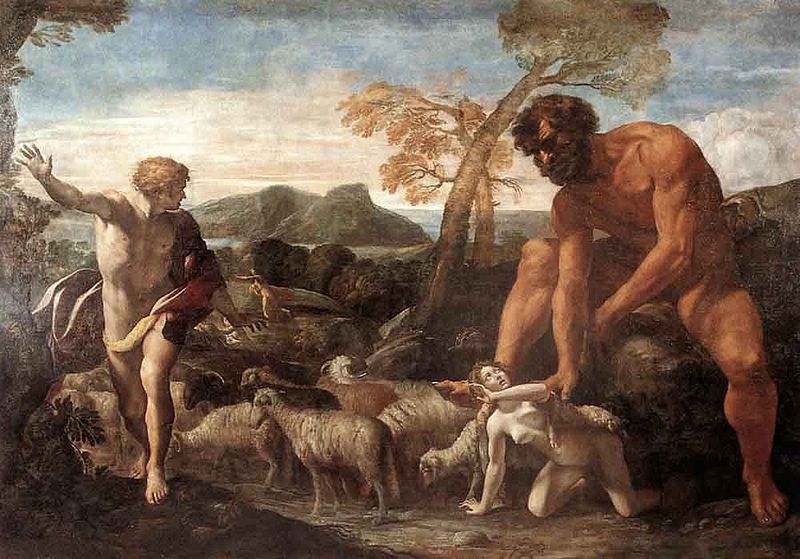 |
| Giovanni Lanfranco's Norandino and Lucina Discovered by the Ogre (1624) |
There is also a female ogress. She is connected with water and less vicious than male ogres.
Ogres are generally viewed as a fear of cannibalism and the degeneration of humans. They show what humans are without their humanity.
Interesting Tidbit: The word ogre is French in origin. Also, it's thought that these creatures are based on the two mythical giants Gog and Magog, which are found in the Bible (in the Book of Genesis, Ezekiel, and 1 Chronicles) and the Quran.
Have you read or watched something with a Nix or Ogre in it? If so, what was it? Also, is there a mythological creature you're itching to read about? Let me know!
Friday, April 8
G is for Gnome
Gnomes are a more recent addition to European folklore. The earliest mentions of them date to the 16th century. Male gnomes wear red pointy caps, have big beards, and usually have a tool belt, which relates to the fact that they're technologically inclined. Female gnomes tend to wear more muted colors, has her hair in braids, and begins to grow a light beard when she reaches 350 years of age. They are very small in size, usually ranging from 5 inches to 2 feet tall depending on the source. Both genders have a very long lifespan.
Gnomes are considered more human than their more unluckier cousins and fierce rivals, goblins. Both are viewed as a type of a earth spirit, but gnomes are known as inventors and alchemists, while goblins use crude but effective tools. Gnomes also tend to be capable of earth-related magic.
There are several different types of gnomes. Woodland gnomes, Dune gnomes, House gnomes, Farm gnomes, Garden gnomes, and Siberian gnomes. Woodland and Dune gnomes avoid contact with humans. House and Farm are good-natured and more likely to interact with humans. Garden gnomes enjoy living in older gardens and telling depressing stories. The Siberian gnome is meaner and takes revenge for even the smallest of offenses.
Interesting Tidbits:
Who are your favorite Gnomes? What books, movies, or games have you enjoyed with them in it? Has anyone seen the newish movie Gnomeo and Juliet?
 |
| German Garden Gnome |
There are several different types of gnomes. Woodland gnomes, Dune gnomes, House gnomes, Farm gnomes, Garden gnomes, and Siberian gnomes. Woodland and Dune gnomes avoid contact with humans. House and Farm are good-natured and more likely to interact with humans. Garden gnomes enjoy living in older gardens and telling depressing stories. The Siberian gnome is meaner and takes revenge for even the smallest of offenses.
Interesting Tidbits:
- The origin of the word gnome comes from Latin word gēnomos, which means "earth-dweller." In the 16th Century, a Swiss alchemist named Paracelsus first wrote about gnomus omitting the "ē," which the OED noted was a blunder. The word as we know it today came about in the early 18th century, but it became popular in the 19th century due to their popularity in children's fairy tales.
- In Scandinavian mythology, they're thought to have always existed but were mostly considered related to other beings, such as fairy or fey.
- During the 20th century, due to the popularity of 19th century fairy tales, gnomes became synonymous with other domestic spirits, which protected the residence and did household chores, losing their distinctness of being tied to earthy, subterranean lives.
Who are your favorite Gnomes? What books, movies, or games have you enjoyed with them in it? Has anyone seen the newish movie Gnomeo and Juliet?
Subscribe to:
Posts (Atom)


